

The Great 8 from the 2026 Detroit Autorama!


It’s that time of the year again- the end of February signals another running of the Detroit Autorama, and with it, the Ridler Award, which has been handed out to one lucky recipient every year since 1964. Named after Don Ridler, the eponymous award is bestowed upon a car that demonstrates an extraordinary amount of creativity in design and modification. To get to one winner, the Autorama employs the talents of some of the country’s top judges to whittle the field of hopefuls down to a select few, known as the Great 8. One of those eight top cars of the show will be selected to win the Ridler Award. This year, nearly 20 cars were eligible, and by Friday afternoon, the Great 8 had been chosen. Here they are in no particular order.
1956 Chevrolet 210 Handyman – Bruce Burns

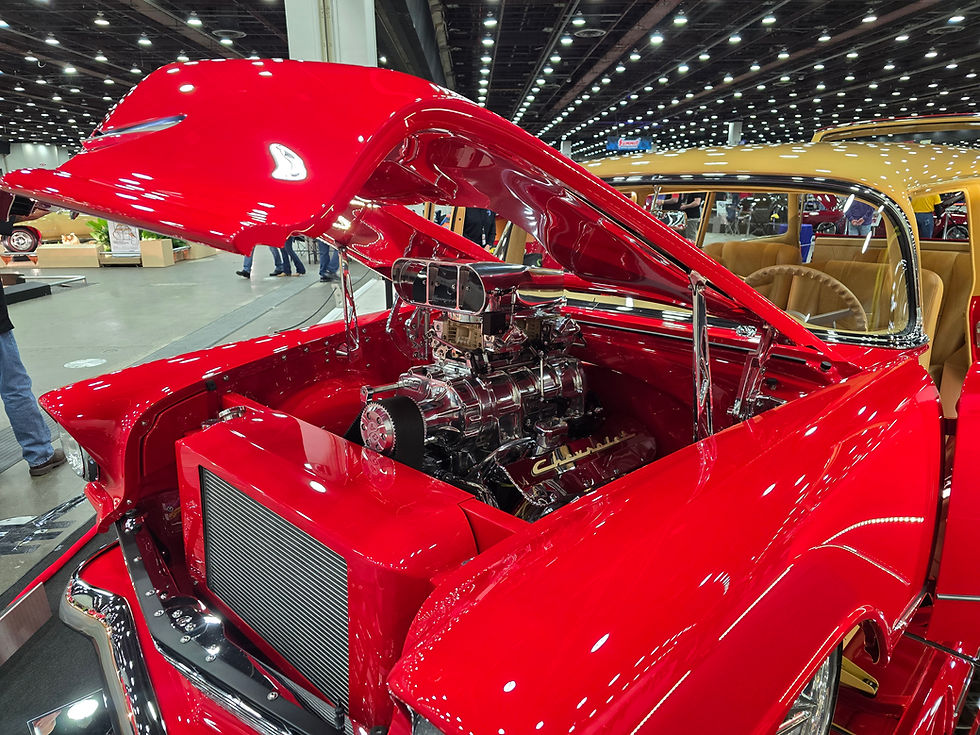
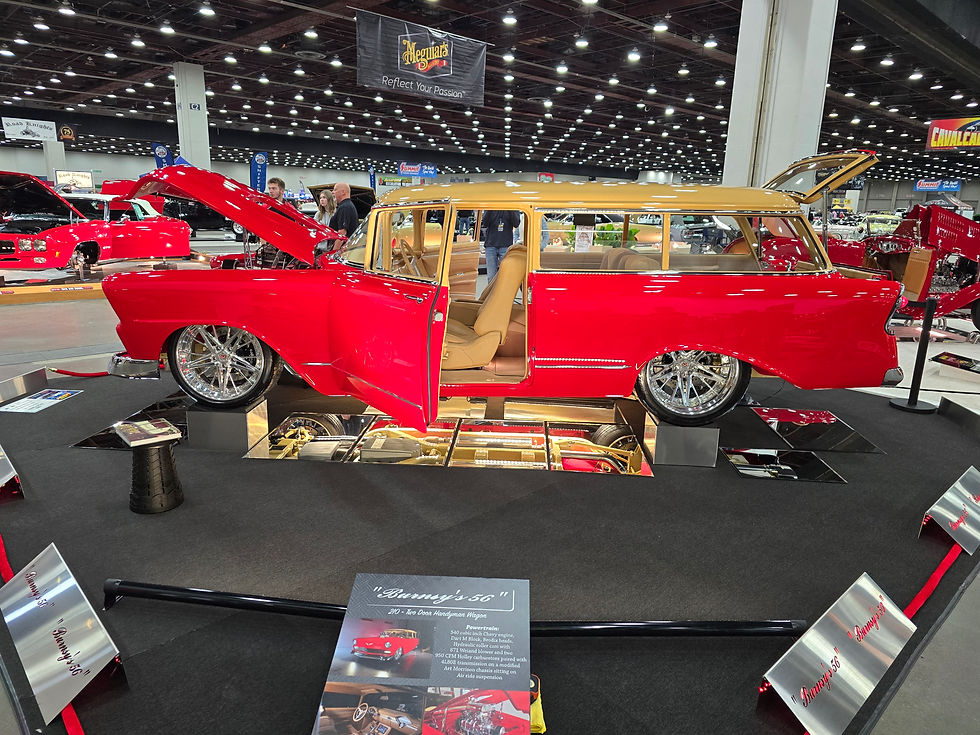


Bruce Burns wanted to build himself a full-sized version of a Hot Wheels car, and he definitely accomplished that goal with this car, named Burnsy’s 56. It checks all the boxes, too, with the big 8-71 supercharger sticking up through the hood, and the big bright wheels as the foundation. The Weiand blower is accompanied by a pair of Holley 950 carburetors, and a 4L80E backs the 540-inch big block. This stylish wagon sits on an Art Morrison chassis with Air Ride suspension for a killer stance. Custom touches include floating, backlit badges and an automated hood that raises and lowers with the push of a button on the key fob.
1959 Cadillac Coupe De Ville – Ryan Bruinsma


One of the most iconic cars from the Tailfin era, the 1959 Cadillac was a styling masterpiece straight from the factory, and it has only been improved by the expert craftsman at Carriage House Automotive Restorations in New Lenox, Illinois. Owner Ryan Bruinsma is a connoisseur of fine cars, but a life-altering medical event prompted him to go all in on the restoration of his dream car. He survived a particularly nasty type of heart attack, and with newfound appreciation for life, he commissioned Carriage Works to build this ’59 Caddy. Like so many stories we’ve heard before, he thought he was starting with a pretty clean car, but a trip to the media blaster nearly sent Ryan back to the hospital with another bout of arrhythmia. Half the car was chicken wire and window screen. Despite that setback, the guys at Carriage Works replaced nearly every panel of the car, then got to modifying it with an Art Morrison chassis, coilovers, and a 9-inch rear. That’s a supercharged LT4 under the hood, backed by a 4L75E transmission. Nearly every panel has been modified and massaged for a sleeker look and top-notch fit and finish. The interior is a particular standout, and we loved the backlit, CNC-machined glass panels in the dash insert and center console.
1968 Chevrolet C10 - Kevin and Wendy Flondor


What do you get when you combine the styling elements of a split-bumper 1970 Camaro and a ’68 C-10? The answer lies can be found here in Detroit as seen in this pickup built by Bump & Grind Auto Body in Homer Glen, Illinois. Up front are the most obvious Camaro treatments, with the bumper and turn signals. The Z/10 badge in the grille also doubles as the hood release. A Roadster Shop chassis and airbags enable the slammed ride height, while a supercharged 6.2L engine provides enough power to perform felony burnouts at will. Check out the hand-made spoiler mounted on top of the tailgate, and in so doing, you’ll appreciate the wooden bed floor that came from the floor of a boxcar- yes, the kind pulled behind a locomotive.
1953 Studebaker Champion – Jim Niedecken


Why a Studebaker? That’s the first question we asked Jim Niedecken, owner of this ’53 Champion Coupe. The answer is obvious: he loves these cars and has owned several of them throughout his 83 years. For this one, he wanted the ultimate Studebaker- something with style, panache, and plenty of power to back up its rakish good looks. To that end, the top has been chopped two inches, much of the chrome has been eliminated, and the body was dropped onto an Art Morrison chassis. Power comes from a twin-turbo LS1 and is channeled through a T56 Magnum six-speed on to a 31-spline Moser 9-inch. Jim says he’s partially color blind, so he let his wife pick this gorgeous shade of red.
1968 Cadillac Coupe De Ville – Richard Jacobs


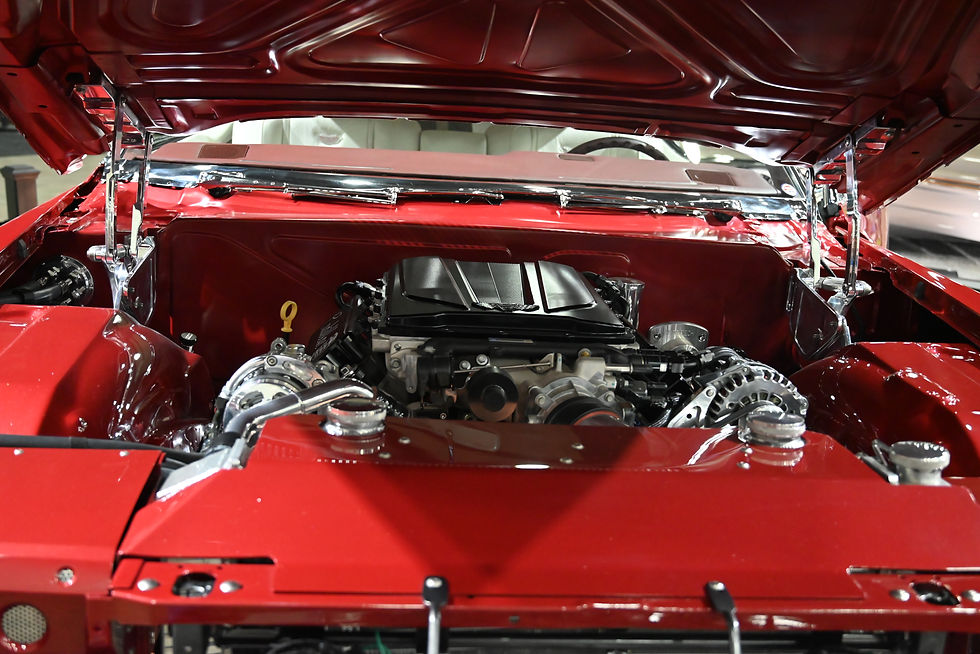

One of two Cadillac De Villes in the running for this year’s Ridler Award, this ’68 is nearly the polar opposite of the finned ’59 on display just 100 feet away. Richard Jacobs loves Cadillacs and has owned them for nearly as long as he has had his license. He said he’s always loved the ’68 De Ville since the first time he saw one when he was 11 years old. He finally has his own version of his first automotive love, and he spared no expenses building it the way he wanted. This one sits on an Art Morrison chassis with an independent rear suspension. Why? Because he wanted it to handle like a Corvette. To that end, it’s got Corvette power under that expansive hood, in the form of an LT4 engine and 8L90E transmission. With long-tube headers and Borla bullet mufflers in the three-inch dual exhaust system, Richard says it sounds like a Corvette, too.
1960 Ford Sunliner – George Conrad


Ford called its convertible version of the Starliner the Sunliner for reasons that aren’t too difficult to fathom. George Conrad went a step further with his car, calling it the Cruzliner and made custom badges stating that fact. Sitting on a Roadster Shop Fast Track chassis, we love that this funky Ford is sporting big power in the form of a twin-turbo Kaase Boss 9 engine under the hood. In the spec sheet, the owner coyly states that the engine is tuned to a “streetable” 1,000 hp. A Bowler TH400 and Gear Vendors overdrive unit channel that gentle power to a Strange 9-inch axle and big Wilwood disc brakes are employed on all four corners to keep speeds in check when necessary. Classic Restorations of southern Indiana began the work, and Rowe’s Rod and Custom took over in November 2023. We loved the sapphire-blue paint job they gave the car.
1956 Chevrolet Bel Air – Rex Satterfield


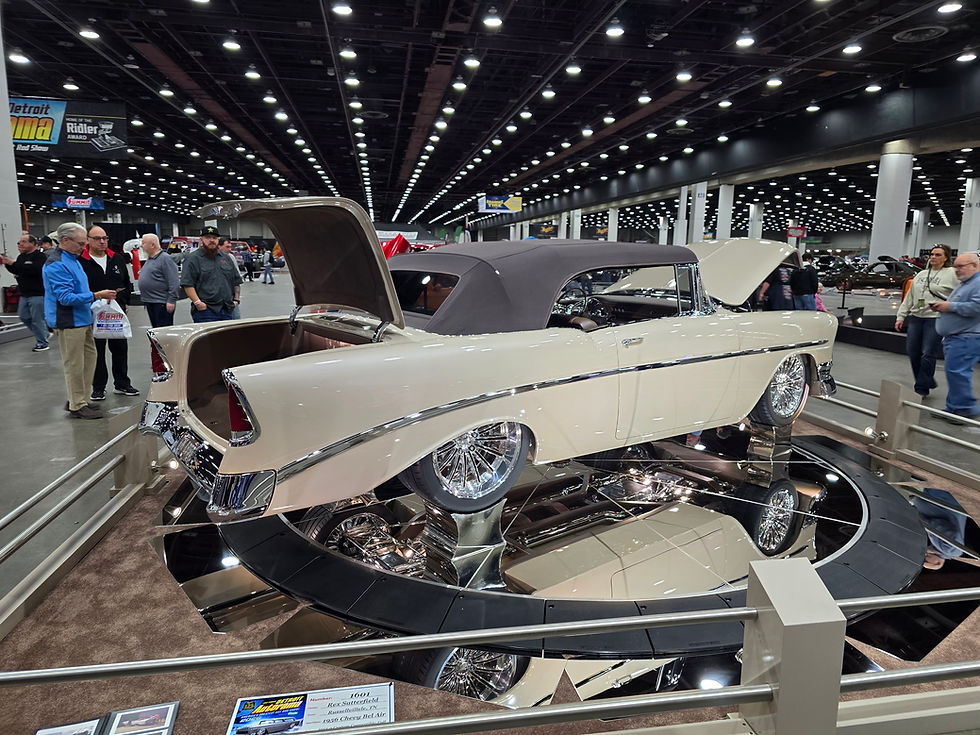


Owner Rex Satterfield calls his ’56 Chevy convertible the Elegant Lady, and it certainly strikes a pose on its turntable display in Detroit this weekend. Yet another car riding on an Art Morrison chassis, this one has been modified with an independent rear suspension from Kugel Street Rod Komponents. Here’s another car reported to make north of 1,000 hp, and judging by the supercharged LS7 under the hood, we aren’t quick to dispute that claim. A 4L80E transmission backs the 427 cubic-inch engine, and there’s plenty of brakes to complement all those ponies. The paint is called Light Coffee, a custom mix, and the dashboard was adapted from a 1956 Pontiac. EVOD Industries made the custom wheels, and sharp eyes may notice the structure of the convertible top was essentially chopped in the back to create more of a sloping appearance when the top is raised. Riffey’s Hot Rod shop took over this nearly seven-year build from Jeff Wolfenbarger who passed away before he could finish the car.
1962 Chevrolet Corvette – Jim Curtis


With the dipped-in-white paint treatment, it’s no wonder owner/builder Jim Curtis named his car Cool Whip. A devout fan of the C1 Corvette, Jim knew he’d paint it in Wimbledon White even before he began construction of the car. Larry Brunkala and Dan Tesar from Precision Hot Rods & Fabrication, in Macedonia, Ohio, built the custom chassis under the ‘Vette, and Jim kept the exterior modifications to an absolute minimum, seeking to preserve the inherent beauty of the last year of the C1 Corvette, and instead making all the chrome, emblems, trim and panel gaps were made to fit perfectly. He let the drivetrain do the loudest talking, fitting a 520 hp LS3 engine and T56 Magnum underneath the sleek fiberglass body. There are 3.50:1 gears in the 9-inch out back, and we love the custom Budnik 18 and 20-inch wheels. Jim reports that a total of three gallons of white paint were needed to fully coat the exterior, undercarriage, frame, and driveline of this Corvette, and that was topped with nearly 10 coats of clear paint with plenty of wet sanding in between. The fruits of his labor are evident in the flawless and glass-smooth finish on every visible surface of this car. That’s impressive.
Text: John McGann
Photos: Street Machine Central


Comments